
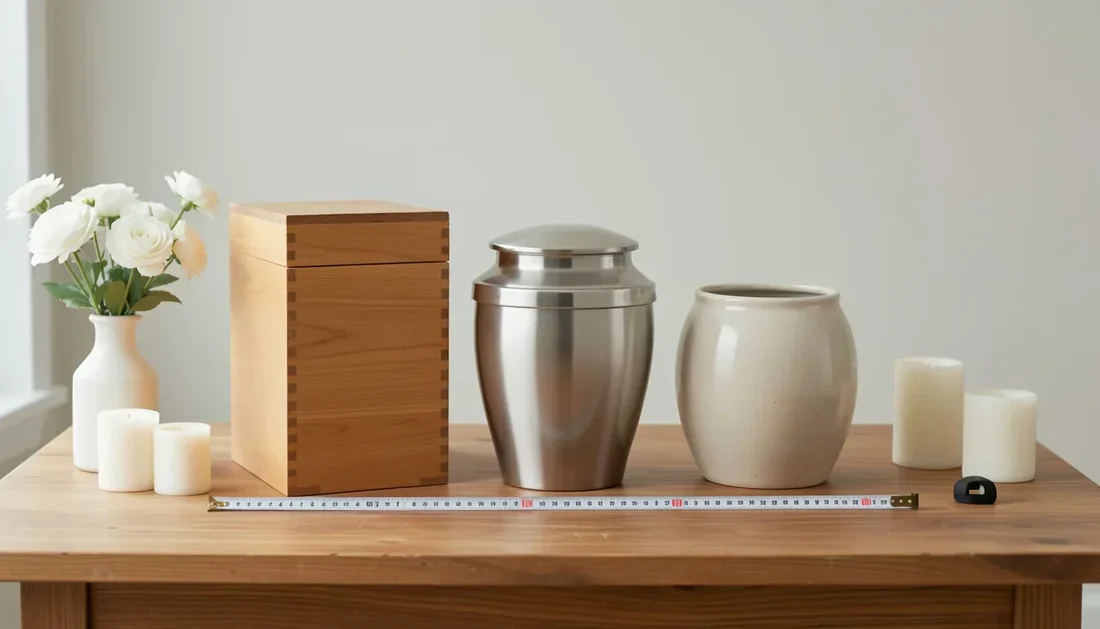
An urn needs to fit in two different ways. Its interior must hold the intended amount of cremated remains, and its exterior must fit the place where the family plans to keep it. A photograph cannot answer either question. Before choosing a color, shape, or engraving, collect the capacity information from the cremation provider and the measurements of the intended location. Those two details can prevent an otherwise beautiful purchase from becoming an unnecessary source of stress.
The process becomes more manageable when the questions are handled in order. First decide how much the urn will hold. Then confirm the required capacity, check the opening, and measure the display or burial space. Finally, review the appearance and personalization. This guide explains those steps and the details that are easy to overlook when comparing products online.
Decide what the urn will hold
Some families choose one container for all the cremated remains. Others keep a smaller portion after a scattering ceremony, divide portions among relatives, or plan for two people to be remembered together. These arrangements call for different capacities. The word “urn” alone does not indicate which purpose a product serves, and similar looking designs may be sold in several sizes.
Write down the intended use before browsing. A useful description might be “one person, all remains, displayed at home” or “a small portion for each of three relatives.” If a cemetery is involved, add its requirements to that description. A short written brief gives the seller or funeral director something specific to work with instead of requiring them to infer the family’s plans from a photograph.
Urns should be compared by their stated internal capacity as well as their appearance. A collection page can help narrow the style, but the individual product specifications should settle the size question. If a listing leaves out capacity, request that information before ordering. Guessing from height or price introduces uncertainty that a simple question can remove.
Understand capacity and exterior dimensions
Capacity is the space available inside a container, commonly listed in cubic inches. Exterior dimensions describe its height, width, and depth. These are separate measurements. Thick walls, a decorative base, a curved shoulder, or a raised lid can make an urn look larger without providing a corresponding increase in usable interior space.
Do not multiply the outside measurements of a decorative urn and treat the result as its capacity. That calculation includes the walls and any empty space surrounding curved surfaces. Even a rectangular wood design can contain a recessed base, internal lining, or an access panel that changes the usable space. The manufacturer’s stated capacity is the relevant starting point.
A hypothetical example illustrates the difference. An urn advertised with a capacity of 200 cubic inches may have enough interior room for the amount recommended by the provider, yet still be too tall for a particular shelf. Another design with the same capacity might fit that shelf easily because it distributes its interior space horizontally. Neither is inherently better; each solves a different placement problem.
Treat sizing formulas as estimates
Many shopping guides use approximately one cubic inch of capacity per pound of the person’s body weight as an initial estimate. Heartland Cremation explains this convention while noting that the amount of cremated remains can vary. It is a planning shortcut, not a guarantee for every person or every cremation. Ask the provider for a capacity recommendation suited to the remains being returned.
If the cremation has already occurred, the provider may be able to offer more useful guidance than a calculation based on remembered body weight. Explain whether all the remains will be kept together and whether the inner bag should remain intact. Ask what minimum capacity and opening would make the transfer practical. There is no reason to measure or handle the remains yourself simply to complete an online purchase.
When two suitable products are close in size, discuss the difference with the provider instead of assuming the smaller one will work. A little unused interior space is generally less troublesome than discovering that the intended contents will not fit. However, additional capacity should not come at the expense of a known exterior limit, such as the dimensions of a cemetery niche.
Check the opening and loading method
The lid seen in a product photograph may not be the point through which the urn is filled. Some designs open from the top, while others have a removable base or back panel. An urn can have adequate capacity but an opening that complicates placement of an existing inner bag. Ask for a photograph or diagram of the access point if it is not shown.
CANA describes cremated remains being placed in a strong plastic bag inside an urn or temporary container. If the family wants that bag preserved, ask the provider whether it can fit through the selected opening. Do not assume that the original temporary container itself is intended to fit inside the decorative urn. Those are different arrangements and may require substantially different measurements.
Confirm who will fill the urn, what instructions accompany it, and whether the closure is intended to remain accessible. A screw secured base, a threaded lid, and a fitted lid are not interchangeable mechanisms. Follow the manufacturer’s directions rather than choosing an adhesive or sealant independently. Future plans, including dividing a portion or transferring to another container, should be discussed before a permanent closure is applied.
Measure the destination carefully
For a home display, measure the surface itself and the clear space above it. Include any cabinet door, shelf lip, or nearby object that affects access. An urn might fit once it is in place but be difficult to lift through a narrow opening. Leave room for careful handling instead of designing a display that requires the object to be tilted or squeezed into position.
A paper footprint can help test the arrangement without ordering the product. Cut a rectangle or circle representing the stated base dimensions, place it on the intended surface, and consider the proposed height. This simple exercise makes a product specification easier to visualize. It also reveals whether a picture frame or flower arrangement would crowd the urn or push it too close to an edge.
For a cemetery niche, request the usable interior dimensions and the clear opening from the cemetery itself. Confirm whether the measurements already account for a door, frame, plaque, or other obstruction. If two urns will share the space, have the cemetery approve their combined arrangement. A general description such as “companion niche” does not establish that every pair of containers will fit.
Plan smaller portions and companion arrangements
A keepsake urn is intended for a portion, so its size should be matched to the agreed distribution. Avoid buying several small containers first and then discovering that the family has different expectations about how much each person will receive. Establish who wants a keepsake, who prefers another kind of memento, and who is authorized to arrange the division with the provider.
When considering a companion urn, ask whether it has one shared chamber or separate compartments. If it has separate compartments, confirm the capacity of each rather than relying only on the total. Also ask how the second placement would be completed later. An attractive single vessel may be less convenient than two coordinated urns if the family wants independent access or expects future plans to change.
Consider location as part of the same discussion. Two siblings living far apart might prefer separate keepsakes and a shared record of the main urn’s location. A couple planning a cemetery placement might prefer two containers that fit the reserved niche. The appropriate configuration depends on the actual arrangement, rather than a general expectation that everyone should choose the same format.
Read the order details before personalization
Before approving engraving, match the product name, size variant, color, capacity, exterior measurements, and opening style against the family’s requirements. Product pages sometimes show several sizes within one listing, and a photograph may illustrate a different variant from the one selected. Save the specification page and the seller’s written answers so the order can be checked when it arrives.
Review the return policy before ordering a personalized item. Ask how the seller handles a capacity question, shipping damage, or an engraving error, and distinguish those situations from a change of preference. Check the delivery estimate against the date the provider actually needs the urn. If timing is uncertain, ask the provider about using an appropriate temporary container while the final choice is completed.
Inspect the empty urn before any transfer takes place. Compare its dimensions and closure with the order, look for visible damage, and verify the personalization under good light. If something appears wrong, keep the packaging and contact the seller before filling or altering the container. An early inspection makes a practical issue easier to resolve while the remains stay securely with their current custodian.
Keep a short record of the final choice
Once the urn is selected, retain a simple record containing the product details, capacity, care instructions, receipt, and placement location. For a cemetery arrangement, add the niche or plot information and the cemetery contact. For a home arrangement, let a trusted relative know where this information is kept. The record is useful if the urn is moved, another family member takes responsibility, or a matching keepsake is requested later.
The most reliable selection process is a sequence of confirmed details: intended contents, provider guidance, internal capacity, access opening, and exterior fit. Appearance remains an important part of the decision, but it is easier to choose confidently once the practical requirements are settled. A suitable urn gives the family a memorial they appreciate and a container that works for the place and purpose they have chosen.


